Neuer Radiobeitrag in WDR 5 Quarks
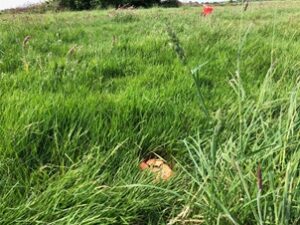
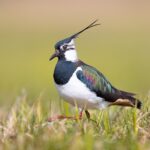
Wieso sind Rinder gleichzeitig Förderer und eine Gefahr für bodenbrütende Vögel? Warum sind virtuelle Zäune aus Tierwohl-Sicht bedenklich oder auch nicht? Für wie wertvoll sehen Landwirt*innen die Einsatzmöglichkeiten virtueller Zaunsysteme an? All diese und noch mehr Fragen werden beantwortet im Radiobeitrag von WDR 5 Quarks vom 07.07.2026 ab Minute 48: https://www1.wdr.de/mediathek/audio/wdr5/quarks/wissenschaft-und-mehr/audio-lesen-smarte-landwirtschaft-schultoilette-100.html
In the spotlight: presentations, discussions and engagement at events in June and July 2026
Over the past few weeks, GreenGrass staff from Göttingen have been attending various conferences, specialist symposia and field events to present the project and its research findings. A brief review:
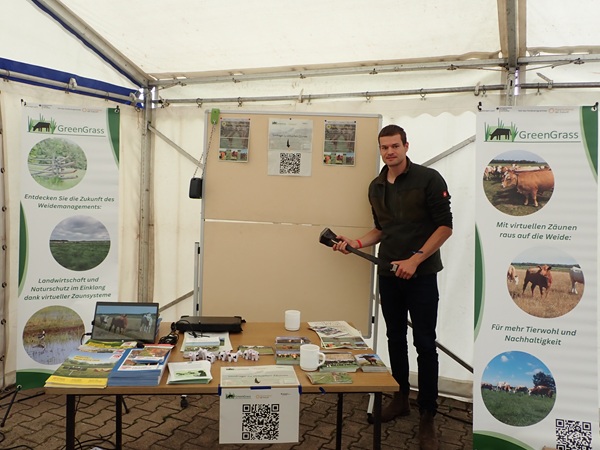
The 2nd Echem Fence Day (on 4 June 2026 in Echem, Lüneburg district), organised by the Lower Saxony Chamber of Agriculture and attended by representatives from 23 companies, 18 associations, 10 federal states and 21 invited guests was very well received by over 200 visitors as an event for information and exchange. At the GreenGrass project stand, we presented our experiences of working with virtual fencing systems – a topic that met with great interest from experts and farmers alike.
At this year’s International Grazing Conference 2026 (9–10 June at the HBLFA Raumberg-Gumpenstein in Irdning-Donnersbachtal, Austria), which was held under the theme ‘Technology, Climate Resilience and Biodiversity’, Leonard Klinck gave a presentation in the ‘Technical Innovations for Pasture Management’ section, outlining the latest findings from his research on ‘The effectiveness of virtual fencing in protecting meadow-nesting bird nests under varying grazing intensities’.
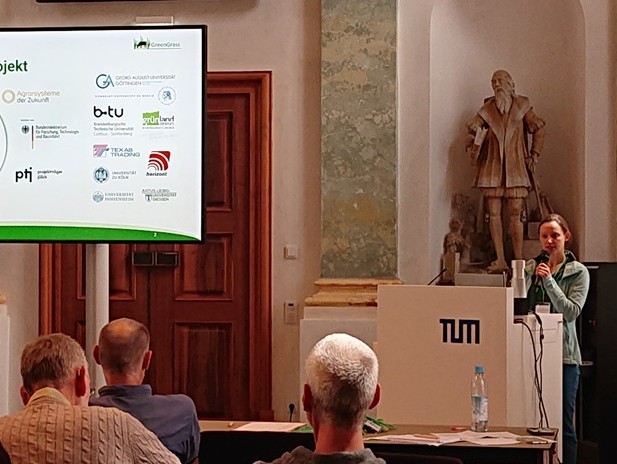
The specialist symposium ‘The Country Needs New Shepherds’, organised by the Bavarian Academy for Nature Conservation and Landscape Planning to mark the International Year of Grasslands and Pastoralism (held on 10–11 June in Raitenhaslach, Bavaria) focused on nature conservation-oriented grazing to promote biodiversity. In a presentation, Dr Vera Pfannerstill outlined the vision of GreenGrass and virtual fencing as a future technology for efficient and sustainable pasture use.
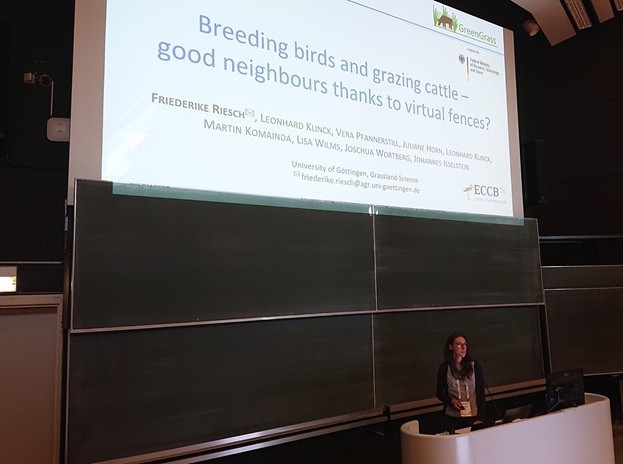
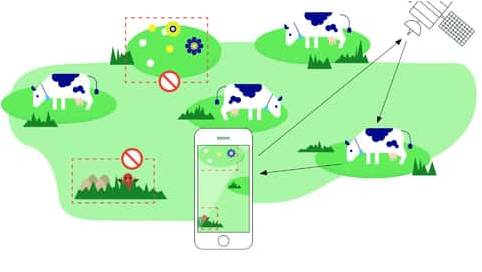
At Europe’s largest congress on conservation biology, the European Congress of Conservation Biology 2026 (6–10 July 2026 in Leiden, the Netherlands), we presented the GreenGrass project with two papers. Dr Friederike Riesch gave a very informative presentation entitled ‘Breeding birds and grazing cattle – good neighbours thanks to virtual fences?’, which explored the impact of grazing on ground-nesting bird species. This topic is of central importance in the current debate on grazing livestock and the conservation of biodiversity in grasslands. We also presented a poster on the general functioning of virtual fencing and its potential for designing conservation grazing schemes, which attracted numerous colleagues fand specialists.
At all the events, we engaged in lively discussions with experts from both research and practice on innovative solutions and potential applications for digital fencing systems – a clear sign of the topic’s growing practical relevance.
Smart farming in the NDR
In a radio feature, NDR reports on our experiments on the Darß peninsula and the potential for protecting birds using virtual fences: https://www.ndr.de/nachrichten/info/smart-farming-vogelschutz-mit-virtuellen-weidezaeunen,vogelschutz-110.html
Press release "Invisible borders, same behaviour"
Topagrar wrote an artcile about a currently published study from GreenGrass1: Virtual fences convince in practical test from the University of Göttingen You can find the press release by the University Göttingen here.
Sharpening our pens
Good research deserves to be read, and that means writing that carries it clearly. With these goals in mind, the young researchers of the GreenGrass consortium came together for a writing retreat dedicated to one of the most important skills in academia: putting our work into words that journals and readers will want to engage with.
From 15 to 17 June 2026, we gathered in Eisenach, a city with a fitting heritage. It was here, high up in Wartburg Castle, that Martin Luther translated the New Testament into German. Stepping away from our work and field sites, we focused on journal paper writing. Through hands-on sessions and shared feedback, we worked on the things that so often slow a manuscript down: structuring an argument, distinguishing results from discussion, and finding a clear, confident story for the paper. The heart of the retreat lay in planning our papers and sharing strategies for writing elegantly, as well as integrating AI tools.
Writing became much easier by comparing strategies and learning from each other's struggles and solutions. Nor was it all work: a hike up to the Wartburg and some thoroughly enjoyable meals together let us recharge and get to know one another. The retreat was as much about motivation as technique. We left with fresh tools, renewed momentum, and a few manuscripts noticeably further along.
The new prototype
“GreenGrass 2.0” is the official title of the second funding phase of our project. This title already points to progress and further development. Such further development is currently taking place at our industry partners Horizont and Texas Trading. They are in the process of developing a new collar for a virtual fencing system, which is set to have more functions than the previous version. On 2 June 2026, we met at the Relliehausen experimental farm with members of our consortium and representatives from the Living Labs to get a first-hand look at the prototype. The way it works was clearly explained using a sample that had been brought along. Thanks to the diverse group comprising livestock farmers, conservationists, researchers and developers, there was a fruitful discussion and a valuable exchange of views. The discussions continued during the informal part of the day. In the afternoon, the programme was rounded off with an excursion to the Solling-Vogler Nature Park and the Solling-Vogler Pasture Cooperative. Here, we were able to see what can be achieved by increasing grazing on the land: species-rich meadows bursting with colourful flowers.
Advisory board meetings at the Living Labs
In the GreenGrass project, our innovative technologies are developed in close collaboration with practitioners. Through this collaborative approach, we aim to ensure that our innovations are practical for day-to-day work on the pasture and help to address the challenges faced there. To this end, each of our project focus regions (Living Labs) has an advisory board in which various stakeholders with regional expertise discuss field trials and innovations with us. Everyone benefits from this exchange – the advisory board members gain up-to-date insights into new research findings and technical developments, whilst we benefit from valuable practical knowledge drawn from the various agricultural systems.
In spring 2026, we met in Relliehausen near Göttingen, in Groß Kreutz near Potsdam and in Ovelgönne near Brake, where we held in-depth discussions on the current status of the software-based multi-level information system (SMI). In Relliehausen, the discussion focused, amongst other things, on how effectively the SMI tool can be used to make decisions on land prioritisation within an extensive grazing system designed to protect species-rich grassland, and whether drone data can be used to record plant phenology. In Groß Kreutz, the focus was for example on the current development of the PastureGuide system and on ways in which herding, separating and identifying animals could be simplified in intensive grassland systems with suckler cows. In Ovelgönne, we focused more closely on the requirements for pasture-based livestock management and discussed how software, remote sensing and virtual fences can be used to support this.
We will now take these valuable insights on board, share them in detail with the entire research consortium, and adapt our research and development accordingly. In this way, we are shaping the ‘agricultural systems of the future’ in a practical and collaborative manner.
Annual meeting and status seminar of the ‘Agricultural Systems of the Future’
Every year, we meet with the entire consortium for an exchange: we look back on the past year and discuss our next planned research work and developments. This time, the meeting took place on 10 November 2025 in Berlin. Our discussions on joint publications were particularly exciting, for example on the significance of the project results for the design of future agri-environmental measures. Immediately afterwards, we took part in the two-day status seminar of the ‘Agricultural Systems of the Future’ project. Here, we were able to contribute to the ‘Sustainability Working Group’ and exchange ideas with employees from other consortia on current topics and potential collaborations. We are already working together with the DAKIS project, we are already working together on decision support software, and with NOcsPS we are connected through drone-based monitoring of agricultural land. We returned home with new ideas and inspiration and look forward to continuing to help shape the ‘agricultural systems of the future’.
Field day on the Darß peninsula
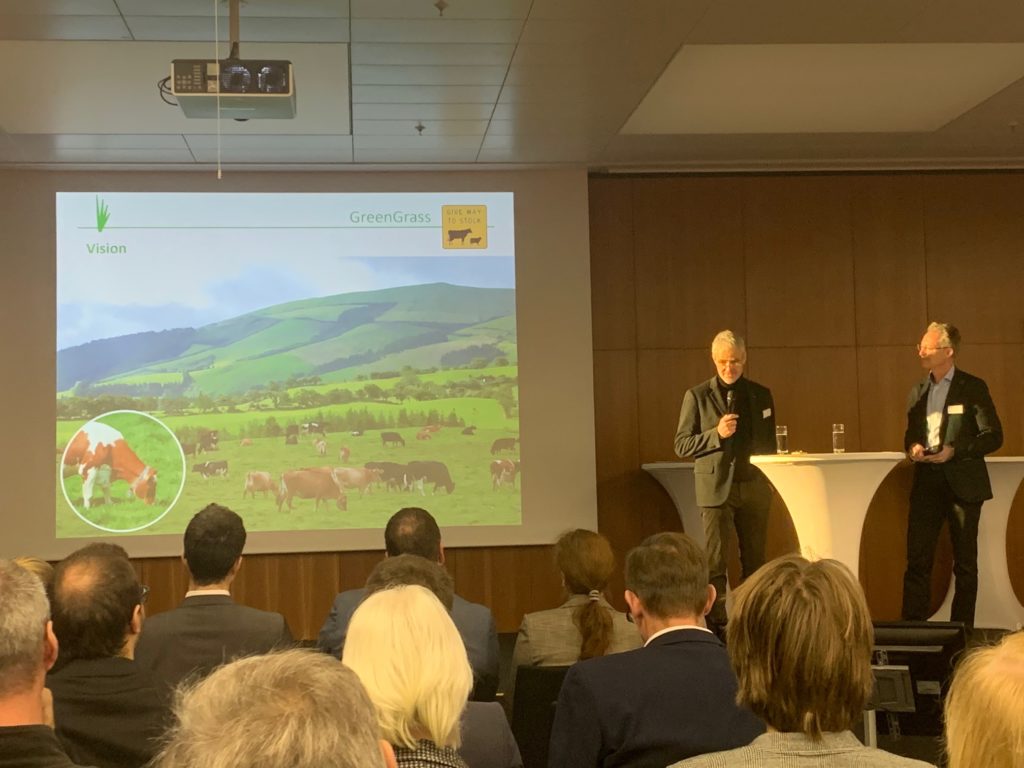
Sunny weather, relaxed cows and a very interested audience – this characterised our field day at the Darß estate on 30 September 2025. The aim of the field day was to communicate our project and, in particular, the concept of virtual fencing to a wider range of practitioners. Our audience of 25 people ranged from farmers to animal welfare officials and national park employees. After a welcome by Marc Fiege, manager of the Darß estate, Prof. Dr Johannes Isselstein from the University of Göttingen first presented the vision of GreenGrass as well as the functionality and advantages of virtual fencing systems. Participants were then able to learn about the individual work packages of the project at various stations. The focus was on animal welfare, legal issues and remote sensing, as well as the application of the decision support software for pasture management developed in the project. The lively discussions and questions showed us that these topics are of great interest. After a covered wagon ride through the beautiful Bodden landscape of the Darß peninsula, the participants were treated to a demonstration of virtual fences in action on the test site. Looking out over the landscape, the potential of virtual fences for biodiversity became clear, and our test animals could be observed grazing peacefully in the pasture. In addition, the participants were able to hold a collar in their hands and ‘learn’ a virtual fence boundary using acoustic signals. At the end of the day, a tour of the farm was offered and the participants were able to round off the field day with a visit to the estate kitchen restaurant. We would like to take this opportunity to express our sincere thanks to Gut Darß for their support and excellent cooperation.
Interview with WDR 5 Quarks
Creating fences with a finger on your smartphone: In an interview on 8 August 2025 by WDR5 Quarks, we explain the advantages of virtual fence systems for farmers from minute 36:27 onwards.
Blog article: How virtual fences can protect birds
In our current experiments, we are working with collars from the Norwegian company Monil. A blog article dated 9 July 2025 here describes how virtual fences can bring nature conservation, species protection and agriculture together.
Report on Deutschlandfunk radio
In its "Current Research" section, Deutschlandfunk reports on the potential benefits of virtual fencing with collars for biodiversity and interviews Prof. Dr. Isselstein from the University of Göttingen about our project. You can find the article from 21 May 2025 here.
Exchange meeting in Cottbus
As a joint project, GreenGrass thrives on its interdisciplinary nature: scientists from the fields of ecology, economics, law and geography work together with commercial enterprises. Regular exchange meetings are essential to facilitate this collaboration. On 20 and 21 May 2025, representatives of all project partners met at the Technical University of Cottbus to discuss the next joint goals. The focus was on data exchange: What data needs to be collected and how, so that it can be used in all work packages? Who can contribute which data that is still missing? And how can the collected data be evaluated and published in conclusive publications? With a ‘roadmap’ for the next upcoming tasks and their timing, we are now well on our way in GreenGrass2.0!
The GreenGrass Portrait Film
On 31 August 2021, our colleagues spent a whole day filming at our test sites in Relliehausen, southern Lower Saxony: virtual fencing, sensors, UAV flights and part of our GreenGrass team at work! The portrait films of all consortia involved in the ‘Agricultural Systems of the Future’ project can be found at https://agrarsysteme-der-zukunft.de/news/2022-05-06-portratfilme-der-konsortien-agrarsysteme-der-zukunft-!
Report on f3: farm.food.future
Virtual fences: the future of grazing? - Article in agrarheute
The revolution in pasture farming: smartphones and GPS transmitters are to be used to manage pasture farming in the future. Researchers at the University of Göttingen are testing whether this really works. Could this be a step towards greater animal welfare? The first test run was positive.
You can find the entire agrarheute article from 11 November 2020 here.
Contribution on 3sat nano
3sat nano accompanied us for a day as we worked on our training experiment with virtual fences. You can find the entire 3sat nano video report from 16 October 2020 here.
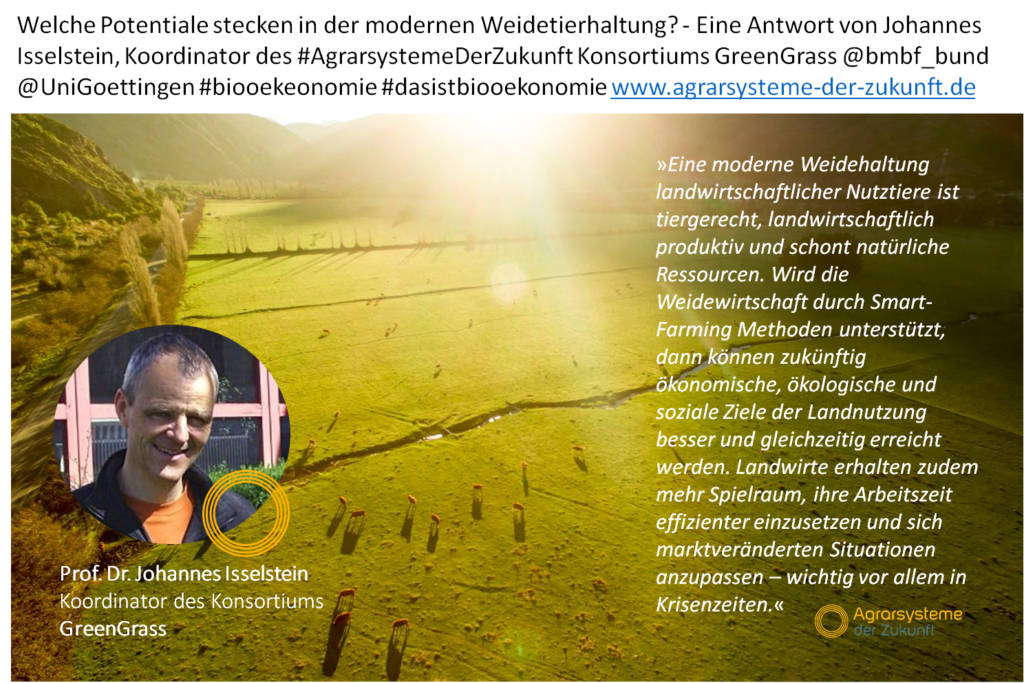
GreenGrass impulse statements at the Global Bioeconomy Summit 2020
GreenGrass at the BMBF status seminar ‘Agricultural Systems of the Future’
On 4 and 5 February 2020, the first status seminar of the Agricultural Systems of the Future took place at the Federal Ministry of Education and Research. All eight projects funded by the programme, including GreenGrass, were presented, and the time was used for networking and identifying interfaces with the other consortia.
The article Smart und nachhaltig – die Agrarsysteme der Zukunft(bioökonomie.de) provides an overview of all funded projects.
Press release from Georg August University of Göttingen
Modern livestock farming increases the pressure to use arable land for feed production. As a result, modern dairy farms no longer put their cows out to pasture. In the GreenGrass project, researchers in a supra-regional and interdisciplinary consortium led by the University of Göttingen are investigating how grazing animals can be brought back into the landscape and how new ways of sustainable and efficient pasture management can be created.
The press release from Georg August University of Göttingen dated 9 September 2019 can be found here.