
Landscape
Remote sensing is a valuable tool for monitoring, assessing and managing agricultural landscapes as well as for nature conservation. Thanks to the falling cost of drones, they are increasingly being incorporated into agricultural practice. According to the German Farmers' Association, almost one in ten farmers now uses drones in arable farming, e.g. to locate fawns in tall grass before mowing or to determine the condition of crops. This allows spatially and temporally coordinated, needs-based measures to be carried out, such as the application of fertilisers and plant protection products or irrigation measures. The use of remote sensing in arable farming, which is already practised today, offers many advantages. On the one hand, it increases work efficiency, saving time and costs. On the other hand, the needs-based treatment of crops enables a more economical and sustainable use of resources, thus reducing environmental impact.
Remote sensing poses particular challenges for recording the availability of forage plants, habitat structures worthy of protection and species in grassland systems due to the small-scale heterogeneity and strong spatio-temporal dynamics of grassland.
The Landscape work package in GreenGrass therefore tests and optimises remote sensing technologies for describing the state of forage availability as well as the habitat and species diversity of grassland with high spatial and temporal resolution.
Satellite-based remote sensing (Geomatics Department, Humboldt University of Berlin): Satellite-based hyperspectral sensor systems, such as the Sentinel satellite system of the EU's Copernicus programme, are suitable for recording and evaluating grassland. With a spatial resolution of up to 10 m and a temporal resolution of approximately one week, this system is well suited for recording the heterogeneity and dynamic changes of grassland.
Drone-based remote sensing (AG GIS and Remote Sensing, Department of Geography, University of Cologne): Drone-based remote sensing is also used in the project. Remote sensing with drones (unmanned aerial vehicles – UAVs) in conjunction with LiDAR systems enables even more accurate recording of the spatial-temporal dynamics of vegetation structures, which are important for birds and invertebrates, for example, thanks to an even higher spatial resolution of up to a few centimetres.
The combination of drone and satellite data enables GreenGrass to conduct comprehensive surveys of landscape and habitat structures, the phenology of forage plants and vegetation, management events and their temporal changes in dense time series. This high-resolution temporal and spatial information is used to control grazing animals across the landscape. On the other hand, the remote sensing data enables the analysis of the effects of innovative grazing production systems on biodiversity.
Furthermore, these subprojects address current challenges such as big data processing of remote sensing data and the development of indices for determining biomass and feed quality derived from spectral data. Cross-scale approaches for the automated processing of data from different sensor sources are also being developed. In the process, machine learning and data mining methods are being further refined.
By upscaling field data collected in reference plots of the study area (ground truthing) using drone data in the cm range, and ultimately satellite data, it should be possible to draw conclusions about forage and habitat availability on a large landscape scale. Through the development and validation of cross-scale approaches as well as automated approaches to data processing, farmers will be able to rely on software solutions and drone data to evaluate and optimize their grazing strategies in the long term. Methods are being developed that process remote sensing data into simple and meaningful quantitative and qualitative measures for grassland management.
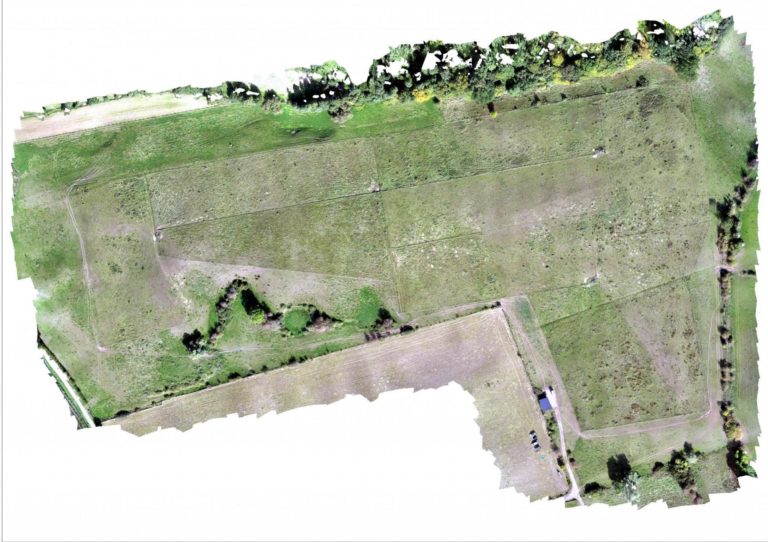
Georeferenced orthophoto of the grassland areas studied at the Relliehausen experimental farm in southern Lower Saxony, based on drone images.
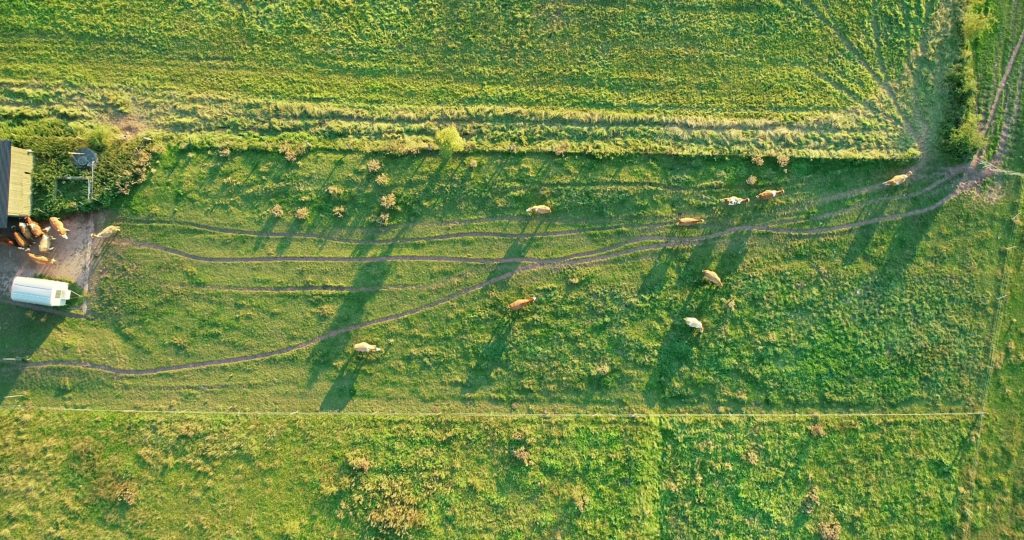
Aerial view of the grassland areas of the Relliehausen experimental farm, southern Lower Saxony.
The Geomatics Department at HU Berlin uses satellite-based remote sensing to record the diversity and dynamic changes in grassland.

Satellite map of photosynthetic activity on the grassland areas of the Relliehausen experimental farm (the redder the colour, the higher the photosynthetic activity).


The GIS and Remote Sensing Department at the University of Cologne uses drones equipped with LiDAR systems to monitor forage plants and habitat structures in grasslands.